Since its launch in 2024, the Tennessee Amateur Communications system has focused on enhancing digital and analog interoperability and reducing fragmentation. This initiative enables stations across the state to communicate seamlessly, regardless of the systems or infrastructure in place in their respective areas, allowing the use of already established repeaters.

Location for Repeaters and Nodes in the western portion of the state to link.
Location for Repeaters And Nodes in the eastern portion of the state to link
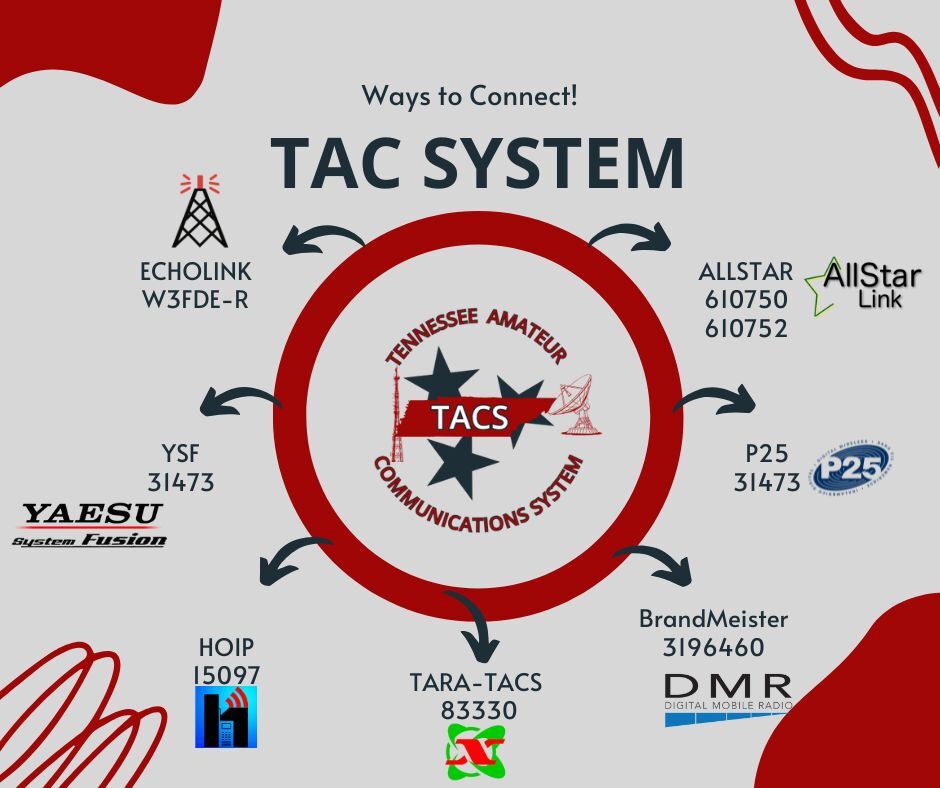
Stations and or repeaters that wish to use echolink should use -R
Our BrandMeister TG is 3196460, and it can be used on any DMR repeater throughout the state!
C4FM users, please connect through a WIRES-X repeater!
C4FM users without access to WIRES-X in their area need not worry; hotspots can connect to our YSF reflector instead.
Use our P25 Talk Group for Networked P25 Repeaters or Hotspots.
Have a VoIP phone? Check out our Hams Over IP extension!
NXDN users can access us through our NXDN Reflector via repeaters or hotspots.
Repeater Name | Freq |Offset| | County |
|---|---|---|
| W4KEV Viking Mtn | 145.410|-0.6|T127.3 | Greene County |
| W4KEV Ski Mtn | 147.195|+0.6|T100.0 | Sevier County |
| W4KEV Knoxville | 145.370|-0.6|T100.0 | Knox County |
| W4KEV Crossville | 147.345|+0.6|T118.8 | Cumberland County |
| N4LMC Signal Mtn | 144.920|+2.5|DCS 73 | Hamilton County |
| W4YI Signal Mtn | 145.440|-0.6|T94.8 | Hamilton County |
| N4OEM White Bridge | 146.955|-0.6|T114.8 | Davidson County |
| AF4TZ Brentwood | 146.670|-0.6|114.8 | Davidson County |
| W4BV | 147.030|+0.6|T114.8 | Lincoln County |
| KK4GGK Graysville | 442.075|+5.0|T110.9 | Rhea County |
| WA4PTZ | 442.100|+5.0|WIRESX | Marshall County |
| N4VFB | 442.700|+5.0|WIRESX | Bedford County |
| N4VFB | 443.350|+5.0|WIRESX | Bedford County |
| W4DMM Tiger Hill | 145.1200|-0.6|CC1 TG 3196460 | Rutherford County |
| Pending | Pending | Coffee County |
| Pending | Pending | Putnam County |
| Pending | Pending | McMinn County |
| Midsouth Linked Repeaters (Pending) | TN/KY Core | West TN and Southern KY |
Why was the Tennessee Amateur Communications System (TACS) built?
The TAC System was engineered to solve a common problem in modern amateur radio: fragmentation. Our mission was to bridge the state's most popular digital voice protocols into a single, seamless network. Like many other statewide systems across the country.
Before breaking ground, we analyzed Tennessee's existing infrastructure and user habits. Our research focused on two key metrics:
Repeater Density: Identifying where connection points already existed and where coverage gaps remained.
Mode Popularity: We found that DMR and AllStar were the primary drivers of digital traffic, with EchoLink maintaining a strong presence.
Seamless Interoperability
By studying areas of overlap, we ensured "continuity of connection"—the ability to travel across the state without losing access. The ultimate goal was to remove technical barriers: whether you are on DMR and your friend is on EchoLink, the TAC System ensures you can talk to each other without worrying about the underlying mode.
A System for the "Volunteer State"
Unlike other networks that are often tied up by massive nationwide or international nets, the TAC System is built by Tennesseans, for Tennesseans.
Always Open: We are available for general use 24/7, not just during scheduled nets or special events.
Locally Focused: We prioritize local traffic and information sharing, keeping the "chatter" relevant to our state.
Expanding West: Our current roadmap focuses on completing full coverage into Region 4 (West Tennessee) to ensure every ham from Memphis to Mountain City is connected.
The TAC System isn't just a network; it’s a tool for unity, providing a reliable home for cross-state communication.
You can connect to the TAC System via over 172 Connection points across the state on repeaters.
You can connect to any of the TAC Systems digital modes using a hotspot of your choosing!
You can even connect via a cell phone running one of the following apps.
Maybe you want to connect via a desktop or laptop? We've got options there as well!